AppBloat: Why Are Mobile Apps So Large?
Modern smartphones are sold with more storage every year, yet many users still find themselves running out of space. The common explanation is that apps are becoming more powerful and feature-rich. Sometimes that is true. Often, however, app size grows much faster than its actual functionality.
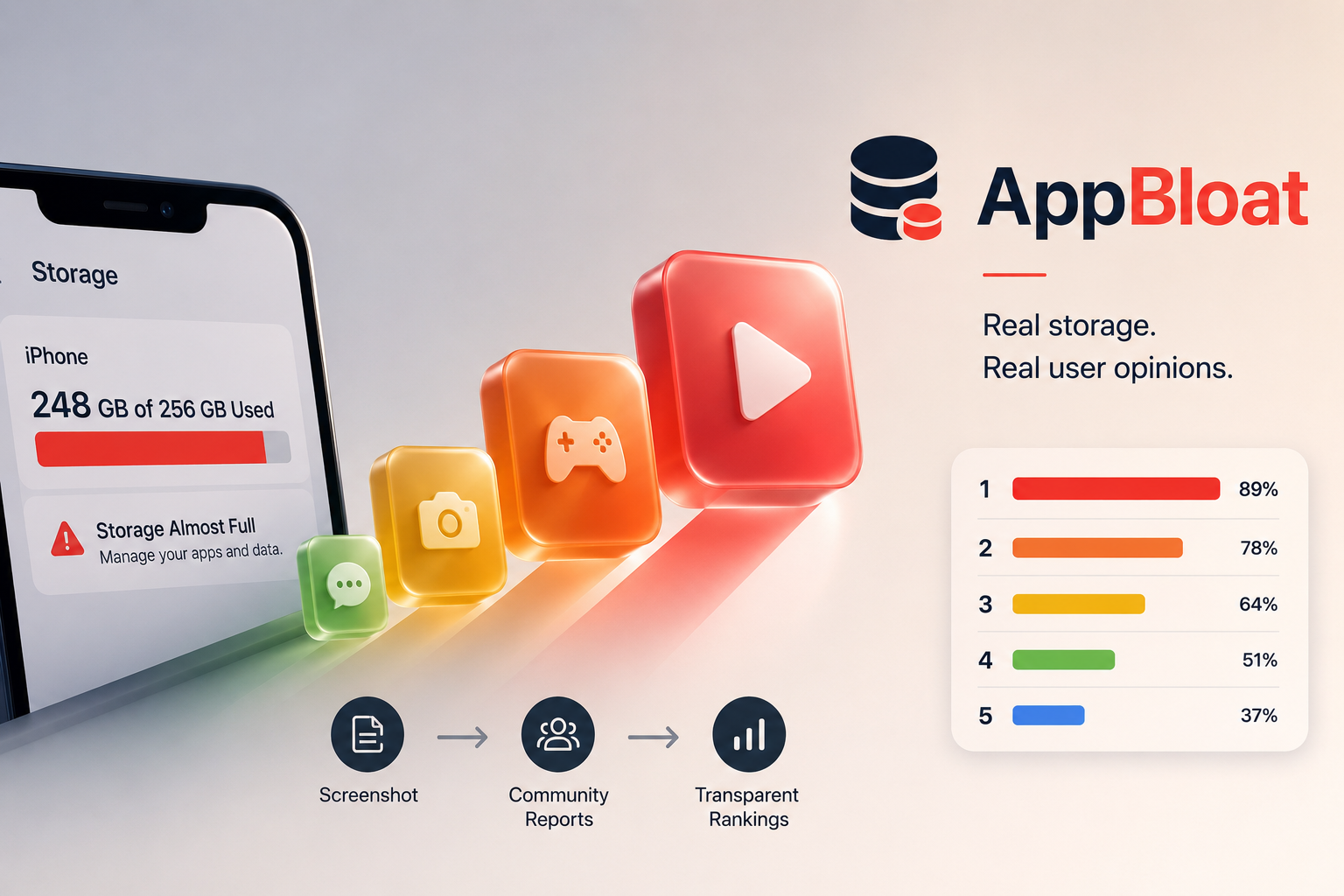
I created AppBloat to make this visible. The project collects real storage usage reports from iPhone and Android users and allows the community to decide whether a particular app's storage footprint is reasonable.
The Problem
As a software developer, I know how much functionality can fit into a small application when storage efficiency is treated as a priority.
One of my own applications combines activity tracking, health records, messaging, social features, statistics, and synchronization. In terms of functionality, it overlaps with several popular apps at once. Despite this, including user data and caches, it occupies roughly 35 MB of storage. Most features continue to work offline, with internet access required mainly for messaging and communication with other users.
Compare that to many popular mobile apps today.
Snapchat is a good example. I have only around ten friends there. I receive very few photos, often just one per day, and those photos disappear after being viewed. The media quality is heavily compressed and the application itself is relatively simple. Yet Snapchat occupies roughly 3 GB of storage on my phone. It is difficult to justify why such a use case should require one hundred times more storage than many fully featured applications.
Apple's Find My app is another interesting case. Its primary purpose is showing locations of devices and people. It does not need to store map data, because maps are already provided by Apple Maps. Nevertheless, it can occupy hundreds of megabytes of storage despite having a very focused feature set.
Uber presents a similar situation. During my use of the app, maps were continuously loaded from the network rather than stored locally. The app itself is conceptually straightforward, yet it can consume hundreds of megabytes of storage.
Why Does This Matter?
Storage is not free. When applications consume hundreds of megabytes or even gigabytes without a clear reason, users are pushed toward more expensive devices with larger storage capacities. They also face larger backups, longer downloads, increased bandwidth usage, and higher energy consumption. At scale, every unnecessary megabyte matters.
Some applications become large because they genuinely need the space. Games, offline maps, video editors, and professional creative tools are obvious examples. But many apps seem to grow regardless of whether their functionality justifies it.
Why Does This Happen?
There is no single explanation.
Some applications cache too much data. Some bundle unnecessary assets. Some accumulate temporary files that are never cleaned up. Others carry years of legacy code and resources from previous versions. In certain cases, large storage usage may correspond to functionality that users never requested or may not even know exists.
The purpose of AppBloat is not to guess the reason. The purpose is to make the size visible and allow users to ask whether it is justified.
How AppBloat Works
Users upload screenshots from their phone's storage settings. For each app, AppBloat collects reports from multiple devices and calculates statistics such as minimum, median, average, maximum, and P90 storage usage.
Every report contains three values:
- App Size – the size of the application itself.
- Data Size – files, caches, and stored content.
- Total Size – the overall storage used by the app.
Users can vote on whether the reported storage usage seems reasonable or unreasonable. Apps are ranked by community opinion rather than by raw size alone, because a 2 GB game and a 2 GB utility app should not be judged in the same way.
The Goal
The goal of AppBloat is simple: encourage developers to think about storage efficiency again.
Software quality is not only about features. It is also about respecting the resources of the devices on which the software runs. Storage, bandwidth, battery life, and user attention are all limited resources.
Most software does not need to be as large as it is today. AppBloat exists to measure that problem, discuss it openly, and hopefully encourage better engineering practices.
Explore the rankings, submit your own reports, and help identify apps that use more storage than they should.